
ASU 2023-09, Income Taxes (Topic 740): Improvements to Income Tax Disclosures

For Nonpublic Entities
Note: ASU 2023-09 provides additional requirements for public business entities (PBEs), for which the amendments were already effective (PBEs with calendar year fiscal year ends for the year ended December 31, 2025), as such, this document focuses on requirements applicable to entities other than public business entities (nonpublic entities).
Executive Summary
In December 2023, the FASB issued ASU 2023-09, Income Taxes (Topic 740): Improvements to Income Tax Disclosures, to enhance the transparency and decision usefulness of income tax disclosures under ASC 740. The standard does not change the recognition or measurement of income taxes; rather, it significantly expands and standardizes certain income tax disclosures, particularly around the effective tax rate reconciliation and income taxes paid.
The most significant changes include:
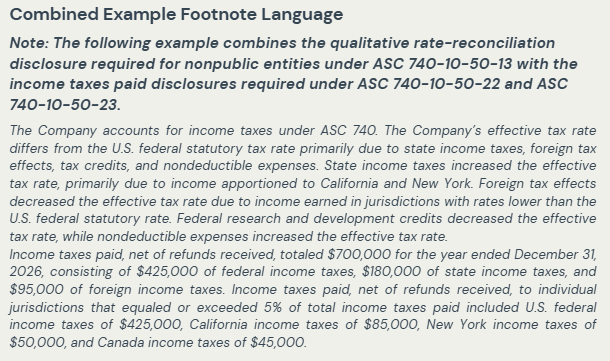
- Entities other than PBEs (nonpublic entities) are not required to provide a numerical effective tax rate reconciliation but must provide qualitative information about significant reconciling items and jurisdictions that cause meaningful differences between the statutory and effective tax rates under ASC 740-10-50-13.
- All entities must disclose income taxes paid, net of refunds received, disaggregated by federal, state, and foreign taxes under ASC 740-10-50-22, with further jurisdictional disaggregation when an individual jurisdiction meets or exceeds the 5% threshold under ASC 740-10-50-23.
- The ASU also requires additional disaggregation of income or loss from continuing operations and income tax expense or benefit from continuing operations, while eliminating certain legacy disclosures, including the reasonably possible 12-month change disclosure for unrecognized tax benefits and certain cumulative temporary difference disclosures.
For nonpublic entities, the amendments are effective for annual periods beginning after December 15, 2025. Early adoption is permitted for annual financial statements that have not yet been issued or made available for issuance. Under ASC 740-10-65-9, the guidance is applied prospectively, although retrospective application is permitted.
Purpose and Background
ASU 2023-09 responds to financial statement user requests for more transparent and comparable information about income taxes. Historically, income tax disclosures under ASC 740 often varied in the level of detail provided, particularly with respect to:
- The drivers of differences between statutory tax rates and effective tax rates;
- The jurisdictions in which entities pay income taxes;
- The relationship between income tax expense and cash taxes paid; and
- The impact of tax planning, tax credits, valuation allowances, foreign tax effects, and uncertain tax positions.
The FASB’s amendments are intended to improve the usefulness of income tax disclosures by requiring more consistent categorization, greater disaggregation, and clearer explanations of material income tax effects. The amendments primarily affect presentation and disclosure processes rather than tax accounting computations themselves.
Affected Entities
ASU 2023-09 applies to entities subject to ASC 740, Income Taxes. However, the scope and depth of required disclosures differ between PBEs and entities other than PBEs.
This is expected to have a larger impact on entities with complex jurisdictional footprints, significant foreign operations, material tax credits, valuation allowances, uncertain tax positions, or decentralized tax payment processes. Other, less complex, entities may not experience an impact to what they have already disclosed for income taxes.
Effective Dates and Transition Under ASC 740-10-65-9 (Nonpublic Entities)
Effective Dates
Under ASC 740-10-65-9:
- Nonpublic entities: Effective for annual periods beginning after December 15, 2025.
- Early adoption: Permitted for annual financial statements that have not yet been issued or made available for issuance.
Transition Method
ASC 740-10-65-9 requires prospective application to financial statements for annual periods beginning after the effective date. Retrospective application to each period presented is permitted.
Implementation Implications of Transition
Entities should evaluate whether prospective or retrospective application is preferable based on:
- Investor or lender expectations for comparability;
- Availability and reliability of prior-period tax payment data by jurisdiction;
- Ability to recast historical rate reconciliation categories;
- Internal reporting system capabilities;
- Audit effort and timing; and
- The expected complexity of prior-year disclosure reconstruction.
For many entities, prospective application will reduce implementation burden. However, entities that present comparative annual financial statements may consider retrospective application if comparative disclosure would be meaningful to financial statement users and historical data is readily available.
Key Disclosure Changes
-
Rate Reconciliation —Nonpublic Entities
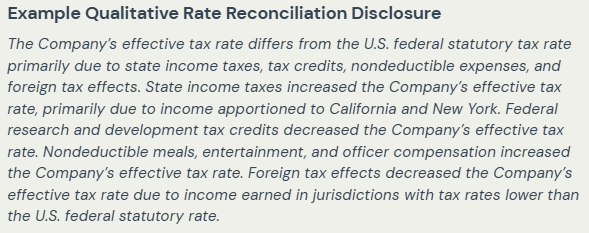
Entities other than PBEs are not required to provide the same numerical tabular reconciliation required for PBEs. Instead, ASC 740-10-50-13 requires qualitative information about the nature and effect of reconciling items.
After adoption of ASU 2023-09, an entity other than a PBE must provide qualitative information about:
- The nature and effect of the eight specific categories of reconciling items; and
- Individual jurisdictions that cause a significant difference between the effective tax rate and statutory tax rate.
The eight categories of reconciling items are:
- State and local income tax, net of federal or national income tax effect;
- Foreign tax effects;
- Effect of changes in tax laws or rates enacted in the current period;
- Effect of cross-border tax laws;
- Tax credits;
- Changes in valuation allowances;
- Nontaxable or nondeductible items; and
- Changes in unrecognized tax benefits.
Practical Nonpublic Entity Considerations
Although nonpublic entities are not required to present a numerical reconciliation, they should still develop an internal process to identify and evaluate the significant reconciling items that drive the effective tax rate. In practice, a nonpublic entity may need a quantified internal reconciliation to support qualitative disclosure decisions.
Recommended steps for nonpublic entities include:
- Prepare or refresh an internal effective tax rate analysis;
- Identify which of the eight categories are relevant;
- Determine which jurisdictions materially affect the effective tax rate;
- Draft plain-English descriptions of significant reconciling items;
- Avoid overly boilerplate disclosures that do not explain entity-specific effects; and
- Document how management determined which reconciling items were significant.
-
Income Taxes Paid
ASU 2023-09 introduces expanded requirements for disclosing income taxes paid. These disclosures apply to all entities.
ASC 740-10-50-22 — Disaggregation by Federal, State, and Foreign
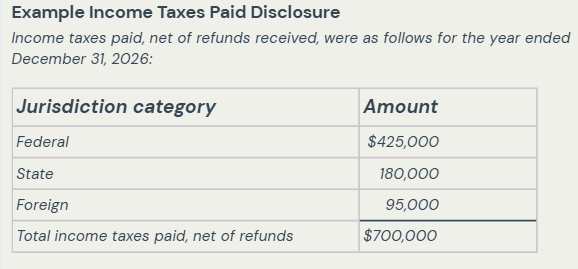
For each annual reporting period, an entity must disclose the amount of income taxes paid, net of refunds received. Separate amounts must be disclosed for:
- Federal income taxes paid;
- State income taxes paid; and
- Foreign income taxes paid.
ASC 740-10-50-23 — Further Disaggregation by Individual Jurisdiction
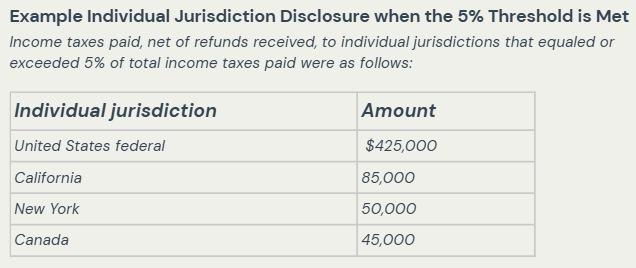
Further disaggregation by individual jurisdiction is required when the net amount paid to an individual jurisdiction meets or exceeds 5% of total income taxes paid, net of refunds received.
For purposes of applying the threshold in ASC 740-10-50-23, an entity compares the absolute value of the net payment or net refund for the jurisdiction with the absolute value of total income taxes paid, net of refunds received.
Practical Considerations for Income Taxes Paid
This requirement may be one of the most operationally challenging aspects of ASU 2023-09 because tax payment and refund data often resides outside the tax provision system, such as in:
- Treasury systems;
- Accounts payable systems;
- Cash disbursement platforms;
- ERP tax payment accounts;
- Local country finance records;
- State tax payment portals;
- Bank records; and
- Tax compliance workpapers.
Entities should assess whether they can capture the following data elements for each payment and refund:
| Data Element | Implementation Consideration |
| Payment or refund date | Needed to determine the annual reporting period in which cash tax activity occurred. |
| Jurisdiction | Must distinguish federal, state, foreign, and individual jurisdictions. |
| Tax type | Should identify income taxes separately from non-income taxes such as VAT, sales tax, payroll tax, property tax, and withholding taxes that may not represent income taxes of the reporting entity. |
| Gross payment amount | Supports reconciliation to cash disbursements and tax accounts. |
| Gross refund amount | Needed to compute net income taxes paid by jurisdiction. |
| Legal entity | Important for consolidated groups and multi-entity structures. |
| Functional currency and reporting currency | Foreign payments may require consistent translation policies. |
| Source documentation | Supports audit evidence and internal control review. |
-
Other Disclosure Changes
ASU 2023-09 also modifies several other ASC 740 disclosure requirements.
Additional Required Disclosures
All entities must disclose:
- The amount of income or loss from continuing operations before income tax expense or benefit, separated between domestic and foreign income; and
- The amount of income tax expense or benefit from continuing operations, separated by federal, state, and foreign jurisdictions.
Removed Disclosure Requirements
The ASU eliminates certain previous disclosure requirements, including:
- The requirement to disclose the nature and estimate of the range of reasonably possible changes to unrecognized tax benefits within the next 12 months, or a statement that such estimate cannot be made; and
- The requirement to disclose the cumulative amount of each type of temporary difference for deferred tax liabilities not recognized because of permitted exceptions related to subsidiaries and corporate joint ventures.
Disclosure Drafting Considerations
Entities should update their ASC 740 disclosure checklists and financial statement templates to:
- Remove superseded disclosure language;
- Incorporate new disaggregated disclosures;
- Ensure domestic/foreign and federal/state/foreign categories are consistently defined; and
- Confirm that disclosure language is consistent with underlying tax provision documentation.
Action Items
Entities should consider the following action items now:
- Determine applicability and effective date
-
- Confirm whether the entity is a PBE or nonpublic entity.
- Identify the first annual reporting period affected under ASC 740-10-65-9.
- Perform a disclosure gap analysis
-
- Compare current income tax disclosures to ASU 2023-09 requirements.
- Identify new disclosures, removed disclosures, and expanded disaggregation needs.
- Assess rate reconciliation readiness
-
- PBEs should map existing reconciling items to the eight required categories.
- Nonpublic entities should develop qualitative disclosure support under ASC 740-10-50-13.
- Evaluate income tax payment data
-
- Determine whether tax payments and refunds can be captured by federal, state, foreign, and individual jurisdiction.
- Confirm ability to apply the ASC 740-10-50-23 5% jurisdictional threshold.
- Update systems and reporting packages
-
- Modify tax provision workpapers, ERP mappings, reporting packages, and disclosure templates as needed.
- Design or update controls
-
- Address completeness and accuracy of data, classification judgments, threshold calculations, and disclosure review.
- Document judgments
-
- Maintain support for category classifications, jurisdictional determinations, transition method, and disclosure conclusions.
- Coordinate with auditors and advisors
-
- Discuss implementation approach, documentation expectations, and interpretive matters before year-end.
- Train stakeholders
-
- Ensure tax, accounting, treasury, accounts payable, local finance, and reporting teams understand new data and control requirements.
AHP Observations
ASU 2023-09 represents a meaningful expansion of income tax disclosure requirements, particularly for entities with complex jurisdictional footprints, significant foreign operations, material tax credits, valuation allowances, uncertain tax positions, or decentralized tax payment processes. While the amendments are disclosure-focused, successful implementation will often require process, system, data, and control enhancements.
Management should begin implementation by performing a disclosure gap analysis, evaluating data availability, documenting judgments, and engaging auditors early. Early planning will help reduce year-end reporting pressure and support high-quality, decision-useful income tax disclosures consistent with ASC 740.